Sunday, July 15, 2018

To the dad who called his daughter a retard...

To the dad who called his daughter a retard...

I never saw your face and you never saw mine.  But the words that you said to your daughter have bothered me since that night and have fueled this blog post.  So in a way, I thank you.

I was sitting in my seat next to my good friend when I heard you.  The small remark that you made towards your daughter that left me so upset.  We were all there to enjoy a concert, and I had a good time, but I still can't stop thinking about what you said.

It was so hot in the 90 degree heat and we were all getting antsy waiting for the band to come on.  I was just enjoying the occasional breeze when I heard your daughter a few rows behind me crack a joke.  I smiled and laughed to myself because she cracked a good one.  But then I heard you reply, "you are a retard" and my heart dropped.  

I know that you will never know how much that hurt me.  That's okay. I just want others to know that what your said is completely inappropriate.  That word is used so casually, that a lot of people don't even realize how much it hurts.  Not just me, a special needs parent, but those with special needs as well.

This word is part of our language and I can't change that.  We all grew up saying it.  Even I am guilty of it.  But now that we are raising children in this judgmental and cruel world, we owe it to them, as well as our future grandchildren, to teach them that these words are no longer acceptable.  

Sir, I hope that you realize that what you said most likely hurt your daughter.  And I hope that when she has children that they are typical because special needs children do not need a grandfather that uses hateful words like that.  And if you are lucky enough to have a special needs grandchild, I hope that you accept them for who they are and you embrace them and help me fight this fight against the "R" word.

Sincerely, 

Fellow concert goer, special needs mom, advocate, and writer.


Sunday, April 1, 2018

It's Been A While

Autism Awareness Month is Here!!!

April is Autism Awareness month and with that comes a lot of excitement!  A whole month for me to share facts with strangers and help them learn to accept others for their differences. 


Autism affects 1 in every 68 children.  That means that 1 family out of 68 is going to have their lives change forever.  They are going to be overwhelmed, stressed, and scared that they are going to fail their children.  I was that parent, and I still am that parent.  


The fear never leaves.  Even as Jaxon improves, my fears change. Instead of being afraid that he will be nonverbal all of his life, I am now worried about how he is dealing with social situations.  I see kids take a ball from him and think it's funny to make him run after them.  I see it, and it breaks my heart.  But I know that I can't be there for every little thing that goes wrong, so I leave it up to God and hope that Jaxon will be able to fend for himself.


Autism affects boys 4 times more than girls.  That doesn't mean that girls with ASD don't need the same amount of awareness and acceptance.  Girls with ASD can be nonverbal just like the boys.  They can be very high functional and be awkward just like boys.  Yet they don't receive a lot of recognition when Autism related posts or graphics come out.


The number of children diagnosed with Autism is staggering. And the fact that it keeps growing year after year is frightening.  Not that these kiddos are scary by any means, but I can't comprehend how fast ASD has grown.  I know the diagnosing criteria has improved greatly in the recent years, but I get to thinking about the poor children 50 years ago who were never diagnosed and treated as if they were of no value because they were different. 


I'm going to rant for a minute here because the facts state that Autism does NOT affect life expectancy.  So why on Earth can't I insure my son?????  Gerber just chose their new Gerber baby and that sweet boy has Down Syndrome.  But what makes me so mad is that Gerber won't insure any child with a disability!!!  Autism is not a death sentence.  Jaxon can live until he's 105.  Autism in no way affects his lifespan, but because he is disabled, I can't get any life insurance for him.


Reeling it back in here.  Whether your child is nonverbal, high functioning, or in the middle of the ASD spectrum, they all deserve love and respect. They are all human beings, and having other people treat them as less than is horrendous. All of these children and adults are a blessing, and this month is not the only time to spread awareness and acceptance. We must do it all year long!  If we don't, who will??


I hope you all will join me tomorrow in wearing the color blue or something Autism related.  Tomorrow is Autism Awareness Day! Spread the love and acceptance everywhere!!!  Please if you have any questions please ask me.  If you are ready to spread the word about our amazing kids and adults with Autism please do! THE ASD WORLD NEEDS OUR HELP!!!


Sunday, February 11, 2018

Busy mama

I have been pretty busy lately, which is a good thing!

I have been struggling with anxiety and depression since this year has started and I have been trying to combat that with being busy.  I joined a professional cosmetics company as most of you know.  That has pumped my mood up so much and I’m staying very upbeat and motivated about that.  It is making me step out of my comfort zone and reach new people.  I have also decided to go back to school in the summer.  Busy busy busy!

Jaxon has been busy as well. He is doing well in school and it’s so sweet that he hugs pretty much every staff member in the school.  He is having more of an attitude problem at home, but I’m trying to work on that.  I’m always so grateful that he has his own voice , but man it can be a turd sometimes.

I have had 2 of my pieces published since I wrote last.  That is super exciting!  It’s nice to know that people will read my thoughts and relate to our life. I love spreading awareness and this is definitely one way of doing it!

We plan on going on a few day trips during Spring Break. So I am anxiously waiting for a much needed break from work and school.  My sanity needs it for sure!  I can’t wait to go to fun places and just have a nice chill week.  Only 1 month left so I think we can make it!

I hope you guys are staying warm and safe.  Major ice problems here so we have been cooped up for 2 days straight so far, but I don’t mind.

Sunday, January 14, 2018

The Autism Roller Coaster

The Autism Roller Coaster

The Autism roller coaster is a ride that you don't have the luxury to depart from.  Once you have paid for your ticket and board the ride, you are on it for life.  No returns, no exchanging your ticket for another ride.

I boarded the Autism roller coaster without realizing it. In 2013 I took my son to his pediatrician for his 2 year check-up.  She asked basic questions and I could tell that she wasn't happy with the answers I was giving her: no he doesn't stack blocks, no he doesn't turn his head towards my voice, no he isn't saying any words. While I was upset at her for making me feel like my son was broken, she was the only person who noticed that something was not right.  So off we went to get a hearing test done. When that was normal, we started Speech Therapy. A little while after that Occupational Therapy started, and not too long after that was the referral.  Now once we were referred and on the waiting list, I realized that we were on a different ride than I wanted to be on.  I wanted a smooth fun ride full of laughs and smiles.  This roller coaster started out with sharp turns and uncertain paths. I would have given anything to get off.

Then in 2014, we were ascending slower to the top of the roller coaster. We were at the specialist.  My son was being assessed by multiple professionals, and finally they came into the room and said the words that rocked me to my core, "Jaxon has Autism". When hearing those words, no matter how prepared you are, you feel like you just hit the top of the roller coaster and you are plummeting down.  You are scared, nervous, and uncertain of how this ride will end.

Once we hit the bottom, we started to move along the twists and turns of the school system.  My son loves school so it was a pretty smooth ride for a while.  But as other Autism parents know, there are smooth parts which are fun and give you a glimpse of hope, and then there are the regressions.  The gut-wrenching regressions where you don't know what you're going to do.  Yet again we are plummeting down the roller coaster heading towards regression.  It came to be that my son had lost all of his words.  How could this happen? We've worked so hard and now it's gone? I'm nauseous and full of uncertainty.  And then, we are at the top of  the roller coaster again where my son gains back all of his words and then some.

We had a nice stretch of fun riding our roller coaster.  Lots of giggles, tickles, and smiles. Until one day, we flipped upside down and we were stuck there.  My child had all of a sudden become aggressive. Aggressive towards me, his grandma, and his classmates.  He had become a child who would hit me and it would knock the breath out of me.  He would kick me in my ribs while standing behind me. He became the child who hit me in front of our family and I got to see the shock on their faces before I left the room to cry it out.  I was mortified. I became the mom who flinched when my child would run up to me.  I was so tense that my body was sore constantly.

You battle being stuck upside down for months until finally, the roller coaster flips you back again.  The aggression dissipates, his vocabulary increases to where he can verbalize himself more.  And while you're riding the fun part of the roller coaster yet again, you're watching and waiting.  Waiting for the next flip, or next sharp turn off of the path that you wanted to be on.  You wait for the next time you are stuck upside down and you prepare yourself. 

Even though this roller coaster can be wild and there are many unexpected twists and turns, there is such beauty in my son. After every setback and every meltdown, the milestones are that much sweeter. Everything we wonk on together feels like we are rising up into greatness and we can conquer anything that comes our way.  I know that all of his teachers and specialists have our back and it's nice to know that there is a village around us cheering us on while we ride this roller coaster.

The Autism roller coaster is not a ride that anybody chooses to ride, but it is what we are on.  So while we are at the top, I will enjoy the view. And while we are fighting our way through the bottom, I will use my strength and push through because I am riding this ride with my heart, my son.


Saturday, December 30, 2017

A Letter To My Child with Autism.

My sweet boy,

I'm writing you this letter that I know you will most likely never read, mainly because I will probably hide it from you.  I have a lot that I want to tell you, but with you only being 7, I feel like this may be too much for you so I will let the public read it instead.

There are things that, if I had the power, I would change to make your life better.  But my job isn't to change the past, but to make your present and future the best that I can.

I can only imagine the struggles you endure in silence every day.  I will never know the extent of your confusion or how your brain processes stimuli.  I will never understand why you are stimming constantly for days in a row and then nothing for weeks.  It kills me to know that you're going through something that I can't see or understand.  I try so hard to try to put myself in your shoes, but there is no way to know how you feel until you are able to communicate with me about it.

I have seen when kids have taunted you or made fun of you, it infuriates me.  I try to educate them because they will be the kids that you will grow up with to try to get them aware and be supportive of you.  I hope and pray that you don't hear their criticisms.  You are the happiest kid in the world, and I'll be damned if the opinions of others, especially kids that are supposed to be your friends ruin your outlook on life.  Just last week I had to explain to a boy why you talked "funny" because I saw him mocking you.  You of course didn't notice, but I did and it broke my heart. After I talked to him about it, I had to hold in my tears and frustration until we were in the car.  I try to not cry in front of you about these situations, but sometimes mama's shield of toughness doesn't do its damn job.

It's been me and you since you were one.  I'm sorry that your dad isn't around.  I'm sorry that you weren’t  lucky enough to have one of those great dads.  I'm sorry that it took me months to explain to you that you didn't have a dad, because you started to notice that other kids had dads.  But you know what? We are doing just fine on our own.  We have each other and you have the best Nana in the world.

I'm sorry that we have to fight about you eating.  Kid, I know you would love to live off of chips and M&M's, but that's not cool with me.  I make you drink your meal replacements drinks because I love you, and you need to stay healthy.  So let's not fight about that anymore.  I think one day you will realize that I'm the "boss".

I absolutely love you, but sometimes I hate Autism.  I hate the struggles that you have to endure in silence.  I hate the constant worry.  I hate the fact that I want the best life for you but that I have to fight for services to help you.  I mostly hate the uninformed population that judge you based off of one meltdown in public.  Screw you judgemental people. I'm not in the mood for you.

You are a strong, resilient boy, and you amaze me daily.  You are VERY stubborn (which you get from me), and we have our moments of who has the higher ground, but Jaxon you have my whole heart and nothing will ever change the way I look at you in awe.

Love you,

Mama


Saturday, December 9, 2017

Underestimating My Child With Autism

WHY DO I ALWAYS UNDERESTIMATE MY CHILD WITH AUTISM???


Since Jaxon was diagnosed with a Autism in 2014, I’ve always pushed myself to be strong enough, smart enough, and loving enough to deal with whatever Autism threw our way.  One thing that I still haven’t been able to do is to stop underestimating Jaxon with everything he does. 

A lot of parents live in fear. Fear of the unknown.  Fear of the future.  Fear that one day on a family outing the unthinkable will happen.  You're child with either have a meltdown or wander off.  Or have a meltdown and then elope from the situation.  My main fear was how do I keep Jaxon safe, but still include him in the things that typical kids enjoy doing.

Today was our town parade.  It was also Jaxon's first parade.  Now Jaxon is almost seven, and some may think that it is weird that I waited so long to take him to a parade.  But I know my child, and until this year I worried that he would either run in front of vehicles, run away from me, or melt down because of the noise.  Those fears plagued me for years so we just never went.  But today was the day that I realized that I underestimate that beautiful boy of mine.  He stood next to one of his cousins and waved and yelled "hi" to everyone that passed by.  He had the sweetest giggle when candy was thrown towards him and he thoroughly enjoyed picking it up and keeping it.  Now there were a few times where he got too close to the vehicles but he listened pretty well and he kept having fun.  Anybody who was around would've assumed that he was a typical kid wanting to get as much candy as he could.

Now I'm never one to make it seem like Jaxon is unable to do things.  He can do anything he wants in life.  He is strong-willed and I love that.  But I, as his sole parent have to be there to guide him and to keep him safe.  Before we do anything new whether it be a parade, a dentist or doctor visit, or even going to the grocery store, I always tell myself that it will probably not end well.  I try not to get my hopes up because I never want Jaxon to see my face become a face of disappointment.  So I keep my fears quiet and act normal with Jaxon when we are in a new situation, but I am fully aware and ready to act if I need to.  And you know what?  Most of the time he rocks it!!!  We leave those situations in our dust! 

A couple of months ago I took Jaxon to a pediatric dentist because I figured if he was going to need any work done he would have to be either fully sedated or at least a little loopy.  We went in and in my mind I told myself, "he may not sit in the chair, he may not let them do anything and that's okay".  We at least had to try.  I had my mind set on Jaxon not going to do well.  But guys, my kid is a rockstar! He hopped in that chair and let her brush, he even took x-rays, which as a dental assistant, I figured he wouldn't be able to do.  I was so amazed at how far my boy has come to be able to sit at the dentist and do what was expected with no meltdown. 

The parade and the dentist are just two stories of how I wanted to kick myself when we were done because I underestimated Jaxon.  Now there have been times when we do have a meltdown in a store, and I'm already in the mindset that that will happen.  I like being prepared.  But what I love even more is being so proud of my kiddo at what he can do!!!  The sky is the limit with these kids.  We just need to be there to help them along and catch them if they fall.

Parents, I think it's fine to prepare for the worst when you're in a new environment.  You need to be ready.  Most of us have an escape plan if a situation turns ugly.  But what I don't agree with is limiting your child's place in this world because you're afraid that something bad, or embarrassing will happen.  Don't avoid going to the park.  Don't avoid trying out the new restaurant in town.  Just go for it.  Just prepare for the worst and when your sweet child excels in the situation, you can be blissfully surprised.


Saturday, December 2, 2017

Tantrums VS Meltdowns

Tantrums VS Meltdowns


Most people think that when a child with ASD is throwing a fit that they're a spoiled child and that their parents need to punish them more.  What people on the outside don't realize is that child is having a meltdown, not a tantrum.

A tantrum is basically throwing a fit to get what you want.  Once that child gets what they want the tantrum stops.  Tantrums are goal-oriented.  The child will watch you for a reaction and will avoid getting themselves hurt.  Tantrums need to be ignored and the child needs firm boundaries.

A meltdown is completely different.  When a child has a meltdown, the part of their brain responsible for executive functioning completely shuts down.  Stress hormones flood their body and temporarily, they are literally incapable of controlling their body and emotions.  They are unable to consider consequences or listen to reason.  

When a child is in the middle of a meltdown, there is no reasoning with them.  You have to nurture and comfort the child.  Keep them safe from things that they could be hurt by and remove them from the situation.  Once the child is regulated and no longer rushing with emotions, you can talk to them about their behavior.

Meltdowns are not goal-oriented.  No demands were made before or after the event.  The child has no interest in your reaction.  They do not care how others react to their behavior.  The child may end up hurting themselves.  They are reacting on a primal level of being overloaded.  They don't try to avoid injury and may be injured during the meltdown.  Meltdowns are slow to end.  They last longer than tantrums, and slow down only when the child acclimates to surrounding at their own pace.  Children during a meltdown are not in control.  Because they are massively overstimulated, they're put into survival mode and react instinctively to the distress they're in. You cannot "snap" a child out of a meltdown.

Usually in most cases, the child will act like nothing happened once a meltdown is over.  It's almost like a blackout moment.

Jaxon has really only had a few absolutely horrible meltdowns.  Most of his meltdowns start out as him throwing a fit because he didn't get his way, and his body and mind become emotionally dysregulated and BAM a meltdown starts.  One meltdown occurred because Jaxon wanted me to back my car in instead of me parking like normal.  He started throwing a fit when I refused to move my car.  Eventually it escalated and became a meltdown.  It was intense!  A few times I thought it was over and it would escalate again.  It was about 2 hours before it was fully over.  Another time, we went to the grocery store after church.  I had to grab a few things and Jaxon's usually a good kid in the store.  Well again he became dysregulated and I had to keep him from flipping the cart over on himself and eloping out of the car.  

I've share the grocery store story on my Facebook page along with the videos that I took.  Jaxon is such a fun goofy kid and it broke my heart to see him like that.  But once it starts you have to ride it out like a storm.  It's heart-wrenching watching your sweet 6 year old turn into a violent, yelling tornado and all you can do is sit there and make sure he is safe until it's over.  Being helpless is the worst feeling. As a parent you want to fix these things, but when your child's brain is wire differently, there's nothing to do.


Sunday, November 19, 2017

When is the right time to tell your child that they have Autism?

When is the right time to tell your child that they have Autism?

 A lot of parents have the same question, "when is the right time to tell my child that they have Autism?".  It is a hard question to answer as each child is different and their age may not dictate when they are intellectually ready to ask what Autism is, or to receive the answer they are given.  

I know of a family who has a very high-functioning child, who as a teenager, still hasn't been told that he has Autism.  The mom told me that she didn't want him to use it as a crutch.  I understand her reasoning, but I am one that believes that if your child knows that they have Autism, it will open them up.  What if that child is being bullied because he's different?  Knowing that they have Autism could help them understand themselves better and they could, if they felt comfortable enough, educate their classmates on Autism.  It could be very empowering to them!  They will realize that the reason that they feel differently about things or why they are pulled out of their regular classes is their Autism and not just them inside their own mind.  As they get older, some of them have greater social awareness, and they will realize that they are being made fun of or ignored for certain things.  It's not fair to the child for them to think that there is something wrong with them.  Autism isn't the end of the world!  Autism is your brain thinking a different way than others.  

A lot of articles I have read say that telling your child about their Autism needs to be individualized to them.  Also, you want to make sure that they are intellectually able to understand.  If they're six and they ask you what Autism is, you want to make sure that you explain it in easy to understand text and not to elaborate so much that they get confused.  Some children are very curious at a young age, and some won't want to know until they are much older.  You know your child best.  Do what you think in your gut is right. Autism is a spectrum, so nobody expects for all of the children to be treated the same, so don't think that what's right for one person is right for everyone else.

Some people are concerned with their child not knowing about their Autism, and having a family member or friend talk about it in front of the child.  If this is your fear, I would address your family and friends about Autism and explain to them that you don't want them talking about it in front of your child.  Explain to them that you want your child to hear it from you and ask that they respect your decision.  I know accidents happen.  If they do, and someone says something to your child about it, it would be good to explain it in a simple way just to help open the door.  The in-depth conversation can happen later.

 Jaxon is almost seven, and a wonderful reader.  So when he sees my shirt that says something about Autism, and looks at me after he reads it, I tell him that he has Autism.  He doesn't follow up with any questions and he just walks away.  That is as far as I have gotten with telling him.  His communication isn't the best still, so I try not to bombard him with it.  

I know that when Jaxon wears his headphones in public that people look as us differently.  It is what it is.  Jaxon needs them to block a lot of the noise in public places.  There are times when Jaxon won't listen in the store and we gets looks.  I don't care.  I always try to wear one of my many Autism shirts when we are out in hopes that people see my shirt and realize what's going on.  I am not one that handles conflict easily and I dread having people judge my child.  Wearing my shirts is one way I spread awareness.  

Some of Jaxon's classmates and church friends have noticed his differences.  They ask me, "Why does Jaxon wear headphones?" or "Why doesn't Jaxon talk very much?".  I answer them as simple as possible.  "Jaxon wears headphones because he doesn't like loud noises or lots of people talking at once."  "Jaxon doesn't talk very much because his brain is different than yours and his brain doesn't let him talk very much right now."  There are ways to explain it to the younger typical children without throwing Autism around.  They are so young and accepting of Jaxon that I just want them to see Jaxon as Jaxon.  When he's screeching really loud, or spinning in circles, I just want the children to say, "that's just Jaxon".  As they grow older I plan on educating his grade on Autism and how Jaxon acts differently because of it. 

I personally plan on telling Jaxon he has Autism whenever he is ready.  If he seems really curious about it, I'll know it's time.  In my reading, I have noticed that kids that are lower on the spectrum don't really care what others think of them. They are having a great time in their own world.  The kids on the higher end of the spectrum are more socially aware and are very in tune with how they are treated.  It is completely up to parent on when to tell their child, and how to explain it to them.  

My advice is to do what your heart feels is right.  Educate your family and friends.  Educate strangers if you have to.  If you want to slowly introduce your child to Autism, read them a book about it and talk about the ways that they are unique.  As they get older and more inquisitive, keep elaborating on it.  One day they will fully understand their Autism and most likely embrace themselves more for it. 

I hope this helps!  Good luck and I'll be praying for you all! 


Sunday, October 15, 2017

The Hard Truth About Being an Autism Parent

THE HARD TRUTH


Being an Autism parent is hard, exhausting work.  The stress is overwhelming.  Even when you're taking some time for yourself, you can't help but to think about things that need to be done, or feel guilty for doing something for yourself this one time.  

Autism parents are faced with continuous challenges ranging from social isolation, financial difficulties, and having a hard time finding resources for their child.  Studies show that raising a child with ASD costs on average, $60,000 on average.  The lifetime cost amounts to $1.4-$2.4 million!  How in the world?  In most 2 parent households, one parent ends up quitting their job to be at home with their ASD child.  So in addition to spending thousands each year, you have now lost one parents' income.  If you come from a single parent household, you either choose to not work and have the state help you, or you continue to work and rely on family to help you with your child.  If I had a spouse and was able to only work part-time so I could be with Jaxon more, I would in a heartbeat.  But I am a single parent and I choose to work full-time because I am lucky enough to have my mom help with Jaxon.  A lot of people aren't that blessed.

ASD parents are on guard 24/7.  Studies have shown that ASD parents experience more stress than typical-developing childrens' parents. Even when we are in a safe space with our child, our mind still races about what could go wrong.  Being in a constant state of hyper-vigilance is emotionally and physically draining.  I have had a friend tell me to relax while we were at a park once.  But she didn't know what I keep secret and the struggles that we have.  I appreciate her wanting me to relax, but I can't do that.

Missing work for your child's therapy appointments, doctor visits, and when you're trying to receive more services can be very difficult.  A lot of people end up staying home with their child because it's easier than worrying about taking off work and possibly losing their job.  I am lucky, because my employer understands and is very lenient about my situation.  

Studies have shown that ASD parents are highly likely to develop anxiety, depression, extreme fatigue, and even PTSD.  Many parents don't get adequate sleep because their child doesn't sleep.  Some finally get to bed, but stay awake fretting about what the future holds.  Studies have shown that Autism mothers have stress levels comparable to combat veterans.  I think that there is no comparison to what our soldiers have been through, but I do understand that our stress level is very high.  

Imagine that your child hits, kicks, yells, breaks things, and self-harms constantly.  Imagine that your child is having another meltdown and is now banging their head against a wall over and over.  Imagine that every time your child ran up to you, you flinched because you're now accustomed to being hit.  That was me a few months ago, when Jaxon went through a hitting phase.  I felt so ashamed that I would flinch when he would come near me.  

There is a lot of worry and stress that comes with being an ASD parent...
  • What happens when I die?
  • Is the school meeting his needs?
  • Will he ever live on his own?
  • Will he ever hold down a job?
  • Will he ever have normal communication?
  • Will he have to live in a group home for the rest of his life?
  • How will I afford all of the sensory equipment he needs?
  • Will he ever eat a normal diet?
  • Is he being bullied?
  • Is he struggling inside his own mind, but can't communicate it to me?
  • How will I financially support him when he's older? 
  • Are we doing too much therapy?
  • Should we try this new therapy?
  • AM I DOING ENOUGH??????????

All of this worry and stress, depression, and fatigue is part of the game.  I know that, but that doesn't make it any easier.  Self-care is so important for parents raising ASD children.  They need to have time to themselves.  To clear their head and calm their body.  A lot of things can help like, counseling, massages, seeing a movie, having dinner with friends, etc.

I personally have gotten massages, pedicures, had a girls night, but no matter what I'm doing, there's always something in the back of my head that's worrying about something.  Whether it's something small about Jaxon or the fact that I feel guilty for leaving Jaxon to have some me time.  I have even gone to counseling.  Talking about my fears and worries help, but it's still hard dealing with the anxiety.

The fear of going out into public.  The fear of people judging Jaxon.  The fear that someone is going to ridicule my son for going into the women's bathroom with me.  The fear of leaving the house, because I'm anxious for no apparent reason.  It is very real and very paralyzing.

I cannot stress enough that if you are having difficulties adjusting to being an ASD parent, or you're going through a rough patch (which I do frequently) please reach out to someone.  Please don't keep it inside, and DO NOT feel guilty about taking a couple of hours to yourself.  You cannot parent your child if you are not taking care of yourself.  I'm good at preaching this stuff, but I myself am still working on it.


Sunday, October 8, 2017

Sensory Issues

 Sensory Processing Disorder

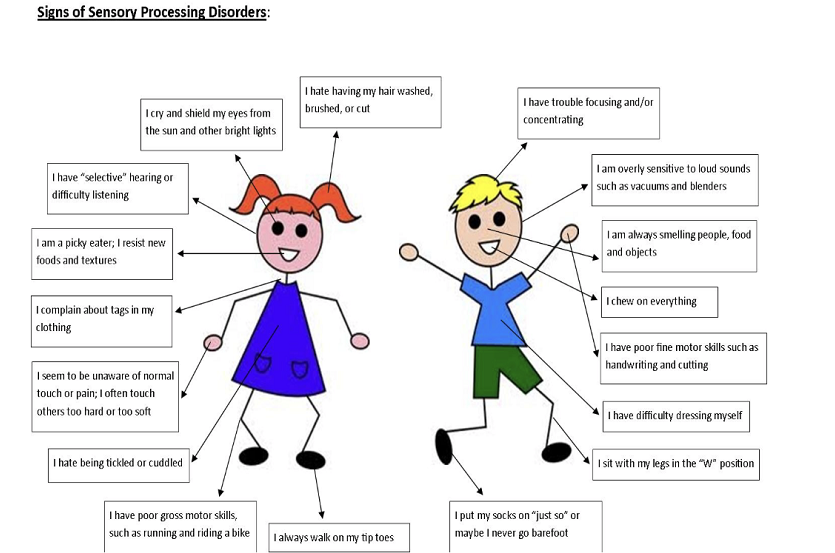
  • Sensory Processing Disorder (SPD) is a condition in which the brain has trouble receiving and responding to information that comes in through the senses.  People with SPD can become oversensitive to things in their environment.  Most people with Sensory Processing Disorder do not have Autism, but studies have found that 3/4 of children with ASD have significant symptoms of SPD. 
  • SPD occurs when sensory signals are either not detected or do not get organized into appropriate responses.  If can affect people in only one sense or multiple senses.  One person may over-respond to touch sensation and find clothing or  physical contact unbearable and another person might under-respond and show little or no reaction to stimulation, even pain to extreme hot or cold.  Sensory Processing Disorder is a spectrum just like Autism.
  • Occupational Therapy and Sensory Integration can help with SPD.  Occupational Therapy (OT) is focused on foster appropriate responses to sensation in a fun way.  Sensory Integration (SI) focuses on 3 basic senses:  tactile, vestibular, and proprioceptive.  Those 3 senses are interconnected.
  • Jaxon has been going to Occupational Therapy since he was 2.  Slowly he has conquered a lot of his sensory aversions.  Jaxon used to hate tags in shirts and he couldn't stand to fingerpaint.  He has come a long way.  His main sensory issue now is noise.  He wears his noise reducing headphones more and more it seems.  He has to wear them to fall asleep, he wears them to church and eventually takes them off, he wears them at school, he wears them when there's not much noise at all.  School is trying to reduce the time with the headphones.  My main thought is now the headphones are a comfort to him, and he doesn't necessarily need them as much as he wears them. 
  • OT has worked with Jaxon by having him do a lot of heavy work like pushing, lifting, and pulling large objects.  He also has worked on his issues with finger painting by playing with shaving cream, play doh, and sand.  OT has been working on Jaxon's vestibular movement by swinging and jumping.  He loves it!  He used to hate vibrating toys,  and would cry when he saw them, but now he loves the feeling!
  • Jaxon has yet to be diagnosed with SPD, and I'm not sure he ever will be.  He has sensory aversions for sure, but they aren't that bad.  They don't hinder his life to where he can't function.  But you never know what the future holds. 


Jaxon pushing the "sled" during an OT appointment.  Heavy work really helps!!!


Saturday, September 16, 2017

Autism and Wandering

WANDERING/ELOPEMENT

Elopement is when a person leaves an area without permission or notification, which can put the person in a potentially dangerous situation.  When I think of a child with ASD wandering away, I think of a child who bolts from a noisy classroom, a hectic home, or just wanders away to follow a frog they have been watching hop around.   But in all reality, a child could elope or wander from a safe, quiet home just as much. 

In 2012 a study stated the top 5 reasons children with ASD wander:
  • Enjoys exploring (54%)
  • Heads for a favorite place (36%)
  • Escapes demands/anxieties (31%)
  • Pursues a special topic (31%)
  • Escapes sensory discomfort (27%)
It has been said that when most children with ASD wander they end up near a body of water.  I'm not sure what it is, but something attracts them to water.  That is why I have heard from numerous people to always check the nearby areas of water first.  Accidental drowning accounted for 91% of total deaths reported in children with ASD after they wandered off.

More than 1/3 of children who wander or elope are never or are rarely able to communicate their name, address, and phone number.

49% of children with ASD attempt to elope from a safe environment and children with ASD are 8 times more likely to wander between the ages of 7 and 10 than their typically developing peers.

Those statistics are frightening!  That is why Autism parents are so vigilant all of the time.  They have to be on their game 24/7.  You have your back turned for 30 seconds and your child could be gone.  It's so nerve-wracking!!!!!  

I remember a time where a friend had told me to sit down and relax.  They have no idea what it's like to have to worry constantly about your child.  Even when you think you're in a safe environment your child can still wander off.  This fear is why a lot of Autism parents have depression, anxiety, and PTSD.  But that will be a different post.

There are a lot of tips for keeping your ASD child safe:
  • Swim lessons
  • GPS tracking devices like AngelSense
  • Medical ID bracelet
  • Having locks high up on the doors
  • Having an alarm for if the door is opened
  • Blocking bodies of water off
  • Alerting neighbors and first responders about your child

I remember when Jaxon was maybe 4 or so, he was obsessed with license plates.  We went to a birthday party and all he did the whole time was walk up and down and look at all of the license plates.  It was fun for him, but very isolating for me.  Anyways, that was the same time where he really didn't have a sense of danger.  If we were outside and a car was coming you would have to stand by Jaxon just to make sure he didn't run into the road.  He loved cars so much.  In parking lots, my grip would be super tight because it's an ocean of cars and he was in heaven.  He didn't care if he walked in front of a moving vehicle or not.

Now that Jaxon is older, he has grasped the fact that things can be dangerous.  But that's not saying that if something really interests him, he wouldn't try to elope to look at it.  It doesn't matter how old our kids with ASD get, we will always stress and worry about their safety.

He always had to look at my license plate when we were outside.


Feeding Issues

FEEDING ISSUES WITH AUTISM

Kids with ASD usually have some sort of feeding issue.  Feeding involves every sensory system (sight, smell, touch, taste, sound).  Many children have sensory processing difficulties which can make eating certain foods very hard on them.Some of them have gastrointestinal issues that they can't verbalize.  They can also develop behavioral problems at mealtime.  They may learn that they can leave the table and play after refusing a food they didn't  like.  Some kids have rituals around food that make it impossible for them to eat anything that's not a certain color, brand, texture, etc. Being persistent and consistent is key.

ASD individuals usually don't like trying new things.  A strategy that is frequently suggested and I personally have heard it at least twice form a nutritionist at an Autism facility is to withhold their food and they will eat what's on the plate when they're hungry.  Yeah right!  This kid is a stubborn beast!  Plus, I'm not going to starve my child.  That's ridiculous.  Studies have shown that 69% of ASD individuals were unwilling to try new foods and 46% had rituals surrounding their eating habits.  So no, starving them isn't going to help unless you want to cause anxiety and meltdowns at dinner. 

Here is list of what Jaxon will eat:

  • cool ranch doritos
  • crunchy cheetos
  • cheddar jack cheese its
  • sour cream and onion pringles
  • chocolate m&m's
  • classic lays chips
  • mini nilla wafers
  • mini oreos
  • mini chips ahoy cookies
  • popcorn shrimp
  • chicken strips
  • fries
THAT'S IT!  I'm also working on cutting down on the artificial dyes in his diet so for right now m&m's and doritos aren't in my house.  Introducing new foods to Jaxon is easy.  He loves to smell them and look at them, but it takes a bit to get him to even lick it.  He will lick a green bean, but he has yet to bite it.  He will bite into an apple but he won't eat and swallow what he bites off.  His diet is extremely limited and that is why he has 3 Carnation Instant Breakfast drinks in the morning, 1 at lunch, and 3 at bedtime.  

My mom and I are so scared that he's starving and won't tell us.  When we go out to eat he used to eat most of his food and right now he's not.  He's getting new molars and losing some more front ones so I know that's some of the problem.  It just stinks when you're eating dinner and he's interesting in what's on your plate and his plate but he has no will to try it.  We always pack snacks for him, because we know that he won't eat what's provided.  It's so hard, but the school tries to work with him on it and we work on it at home, so hopefully one day it will improve.


Jaxon at a birthday party eating chips that we brought.  What I wouldn't give for him to try a piece of birthday cake!


Saturday, September 9, 2017

Occupational Therapy

OCCUPATIONAL THERAPY

Occupational Therapy (OT) is an intervention that is child-centered and is designed to help a child build on areas of strength and improve skills in areas of weakness.  Often times a therapy session looks like a lot of play.  Occupational therapists take in account the physical, social, emotional, sensory, and cognitive abilities and needs.  ASD kids are slower to integrate imputs coming in from their senses which makes their processing speed a lot slower.  

Occupational Therapy work on the following intervention areas:
  • Fine Motor Skills - development of small muscles needed for fingers to pick up small items, handwriting, getting dressed.
  • Visual Motor Integration - hand-eye coordination, such as picking up small pieces of food from the plate and getting it to the mouth.
  • Gross Motor Coordination/Postural Stability - walking, standing, running, gross play skills
  • Cognition and Perception - thinking and problem solving, such as trying to figure out how to get a toy out of a box.
  • Sensory Processing - integrating information coming in from the different senses, such as adjusting your walk from a hard surface to sand.
  • Environmental Modifications/Adaptive Equipment/Technology - modifying the environment so a child can "do" the "work", such as sliding a special pencil grip onto the pencil to it can be held securely for writing. 

OT can also help a child stimulate their Central Nervous System during activities as well as demand the brain and body to work together while the child is "playing".  Heaving lifting and deep pressure also help the child stay calm and increases the ability for self-regulation.  Children do better when they are approached in a fun way.  Kids during an OT session could build with blocks, color, play games, do puzzles, practice dressing themselves, draw, cut and glue and many other things that help the child without them really noticing because it's fun!

Jaxon has been going to OT since he was 2.  Since then he has improved so much!  I remember one day he just starting drawing and writing.  He used to hate it and then poof!  After that took off so did cutting things out.  Now drawing is his favorite thing to do and it shows his personality when he writes "books".  He has gotten over his aversion to paint and shaving cream on his fingers, and now he really enjoys it.  He also has gotten over his hatred of vibrating animals and objects.

When Jaxon is in OT he enjoys swinging.  It helps calm him.  He also enjoys jumping and doing puzzles.  I've included some pictures of him in an OT session.  Jaxon can go to Occupational Therapy well into adulthood if needed.  As long as he keeps improving I couldn't imagine a time where he wouldn't have OT because there is always progress to be made.